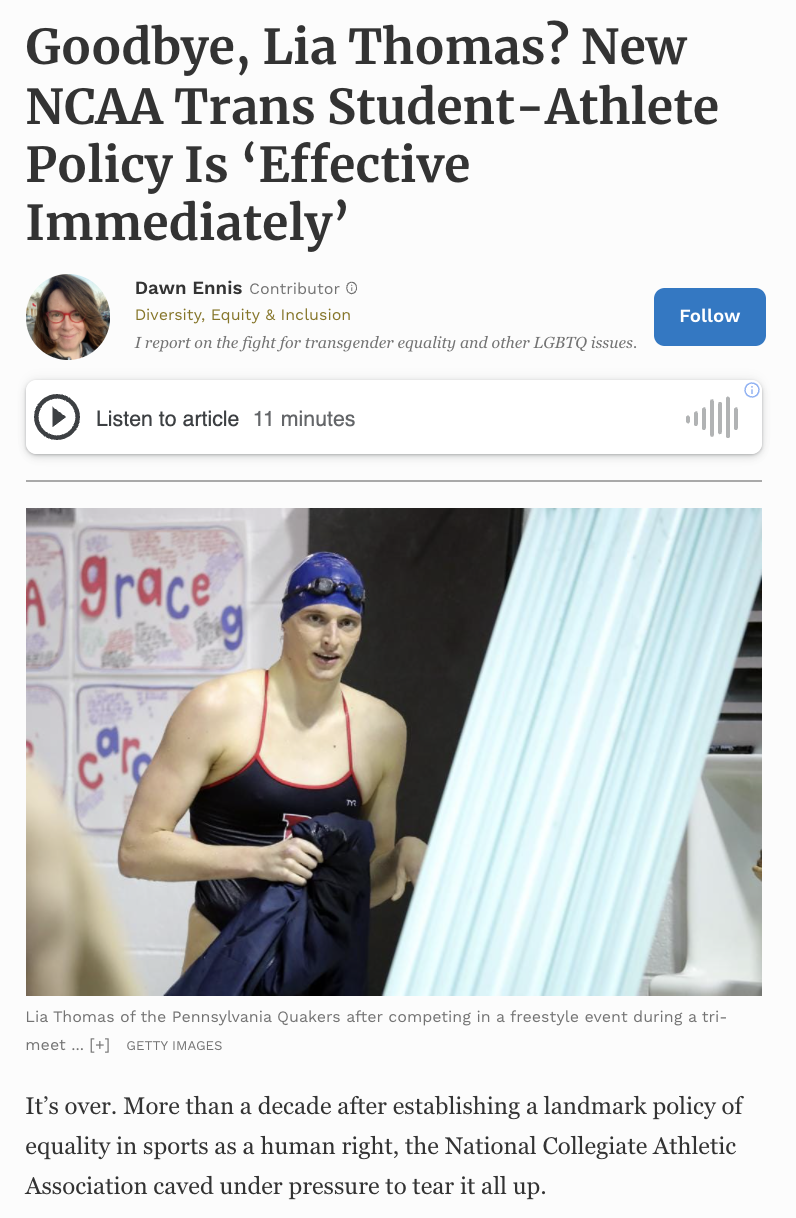
And just like that, my work has hit a standstill. All of the blood, sweat and tears that I’ve cried in advocating for transgender athletes has vanished in the matter of days.
The NCAA announced several days ago that they have changed their transgender inclusion policy, what critics argue is largely in response to the “threat” of transgender swimmer Lia Thomas. Previously, their guidelines were quite binary in nature and specified eligibility for transgender athletes assigned male at birth (trans women), as well as those assigned female at birth (trans men). However, their new guidelines, which they argue “follow the IOC’s [International Olympic Committee] 2021 updated guidelines,” do just the opposite. Despite getting rid of specific rules about surgeries and hormones, the NCAA says it is now up to individual governing bodies to determine which transgender athletes are eligible to compete. For Lia Thomas, USA Swimming is the governing body of NCAA swimmers, and require athletes to submit hormone levels several times throughout the year and maintain testosterone levels under 10 nmol/L. Essentially, despite previously competing and being in full compliance with the NCAA regulations, now she can be barred from sport at any time.
In addition to the case of Lia Thomas, what I take the most issue with is that the NCAA caved; they had long since been seen as becoming more inclusive of trans athletes, only to take many steps backward with this move. Additionally, they are absolving themselves of responsibility for determining eligibility, which makes everything even more complicated. Without having set guidelines, whether they are sport-specific or not, the NCAA has essentially thrown in the towel. As the largest governing body for collegiate sport, they have a responsibility to protect all of their athletes and encourage participation, and with this new policy, they are doing just the opposite. I imagine that this new policy is going to make “compliance” a nightmare to track.
I can’t even begin to describe how upset I am at this. Sure, there are issues of fairness, but what even is fair? Michael Phelps isn’t barred from competition because of his unique lack of lactic acid production; he’s considered “genetically gifted.” It’s also not like hormones immediately give people superhuman strength. It still takes years and years of training to be good at sport, and this is something that opponents of transgender inclusion often overlook.
But what saddens me the most is that college sports don’t exist in a vacuum. Many high schoolers aspire to compete in the NCAA one day. And for people like my 8-year-old transgender cousin, seeing that people like Lia Thomas are not welcome in sport can be absolutely devastating.
I’m not saying that there’s any easy solution here. But it’s clear that this “updated” policy was created out of haste, not out of “sound medical knowledge and scientific validity,” as the NCAA previously claimed.
Transgender people belong in sport. And most of us don’t want to compete as “other” for the sake of fairness, we just want to play.
 Home
Home 